October 29, 2026
Four Leaders, 35 Years: Reflections on AREF’s Past and Future
By Alberta Real Estate Foundation
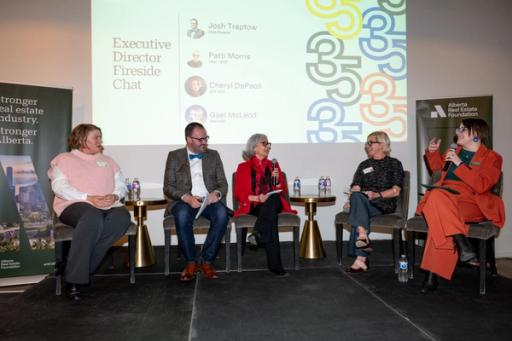
At AREF’s 35 Years of Impact celebration, four Executive Directors came together to reflect on the challenges, decisions, and opportunities that have shaped the Foundation and what it will take to remain relevant for the next 35 years. Check out the event photo gallery here.
It isn’t often that an organization gets to bring together the leaders who have shaped its entire history.
At the Alberta Real Estate Foundation’s (AREF) 35 Years of Impact celebration on October 26, founding Executive Director Gael MacLeod, joined former Executive Directors Cheryl De Paoli and Patti Morris, and current Executive Director Josh Traptow, for a conversation about the Foundation’s evolution.
Moderated by AREF Grants Manager Sarah Stuebing, the fireside chat offered a rare opportunity to look back across four eras of leadership. There were stories of early challenges, difficult decisions, ambitious ideas, and a few laughs along the way.
What emerged was a shared belief in the importance of taking risks, bringing people together, and supporting work that benefits Albertans.
Four Eras of Leadership
Each Executive Director inherited a Foundation facing a different set of circumstances.
For Gael, the early years were an uphill battle. The Foundation was new, its funding model was unfamiliar to many in the real estate industry, and securing the revenue needed to begin funding projects was no small task.
“I spent the first couple of years with compliance, just trying to get revenue at all,” she recalled.
Cheryl took over during a period of historically low interest rates, when the Foundation had to scale back operations and carefully manage its resources. She worked closely with financial institutions to improve the interest earned on real estate trust accounts, strengthening AREF’s ability to fund projects.
As funding capacity improved, the Foundation embraced an important role in Alberta’s funding landscape: being an early supporter of promising ideas.
“We couldn’t be the largest funder; we could be the first in,” Cheryl explained.
Under Patti’s leadership, AREF entered a period of renewal. The team revisited everything from governance and grantmaking to its strategic direction and relationships with interest holders, creating a foundation for its next chapter.
Today, Josh is building on that work, expanding relationships with organizations across Alberta and exploring how AREF can respond to emerging needs.
While the challenges have changed, each leader has helped shape an organization that continues to learn and adapt.
A Broader Understanding of Real Estate
The conversation also explored how the Foundation’s understanding of real estate has evolved over 35 years.
In its earliest days, AREF supported industry education and professional development. Over time, its investments expanded to include affordable housing, land stewardship, energy efficiency, environmental sustainability, and public policy research.
Gael recalled an important principle that helped guide this evolution:
“This is public money for public benefit.”
That distinction has remained central to AREF’s work. While the Foundation’s funding comes from interest earned on real estate trust accounts, its investments are intended to benefit Albertans.
Patti shared how an exercise to better understand AREF’s impact revealed that the work of its grantees aligned with the mandates of more than 10 provincial ministries.
It was a reminder of how interconnected real estate is with the issues facing communities, from housing affordability and public health to environmental protection and land use.
The Value of Being First—and Bringing People Together
Some of the evening’s most memorable reflections centred on the projects that began with an idea and a funder willing to take a chance.
Patti recalled meeting with the founders of the REET Institute, who envisioned creating pathways for underrepresented youth to explore careers in commercial real estate.
The idea was ambitious, and the organization was still in its early stages. There were practical questions about how the program would operate and whether its founders had the capacity to bring their vision to life.
AREF became an early funder, helping the initiative get off the ground. Patti later had the opportunity to watch its first group of students complete the program.
The story illustrated a recurring theme: sometimes the most valuable contribution a funder can make is helping an idea gain momentum.
Other examples highlighted the lasting value of accessible information, including Evict Radon’s public health research, the Pembina Institute’s Landowners’ Guide to Oil and Gas, and landlord and tenant resources developed by the Centre for Public Legal Education Alberta.
The panelists also emphasized that AREF’s contribution isn’t always financial. Introducing organizations to potential partners, helping grantees strengthen their proposals, and connecting research with the people who can use it are all important parts of the Foundation’s work.
Making Room for Risk and Learning
Looking ahead, the conversation turned to what AREF—and philanthropy more broadly—must be willing to do differently.
For Gael, the answer was straightforward.
“I think being gutsy. I think being a leader.”
Patti reflected on the importance of being comfortable with uncertainty, particularly when supporting innovative projects.
“I love too that there has been a culture of failure, failing forward, and embracing the fact that sometimes when we take those risks, it’s not going to work, but we’re going to learn, and we embraced that.”
The discussion extended to how funders can better support the organizations they work with. Cheryl highlighted the growing movement toward trust-based grantmaking practices, which seeks to reduce unnecessary administrative burdens and give organizations greater flexibility.
The panel also considered emerging challenges, including artificial intelligence, changing land uses, and the need for reliable research to inform public policy.
Across these topics, the message was consistent: staying relevant means remaining curious, listening to communities, and being willing to try new approaches.
Looking to the Next 35 Years
As the conversation drew to a close, Sarah asked the panelists what AREF should never stop doing.
Their responses reflected the values that have carried the Foundation through 35 years: demonstrating leadership, serving the public interest, bringing people together, and sharing the stories of grantees whose work is making a difference.
Josh spoke about his hope that future leaders will inherit an organization that continues to evolve, take risks, and convene conversations that lead to meaningful partnerships.
For Patti, celebrating the creativity and accomplishments of AREF’s grantees was equally important. After all, the Foundation’s history is inseparable from the people and organizations it has supported.
Sarah captured that sentiment in her closing remarks:
“You’re not just an audience for AREF’s story. As our grantees, our board, industry partners, our interest holders, you’re part of the reason that the story is actually worth telling.”
Projects
Contributor

Alberta Real Estate Foundation
The Alberta Real Estate Foundation invests in real estate* policy, research, practices, and education that strengthen Alberta’s communities.

Similar News