November 4, 2026
The Impact of Radon Research in Alberta
By Alberta Real Estate Foundation
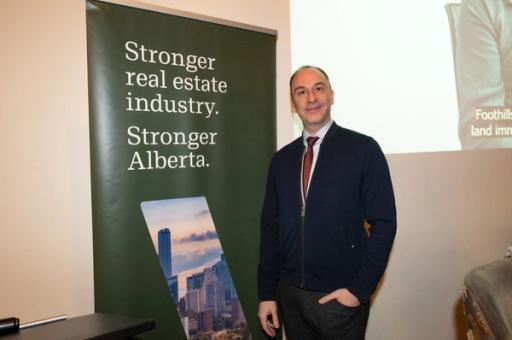
Natalie Scollard pulled six months of sales data from the Calgary real estate market. More than 100 listings mentioned radon in the property remarks. Sellers were including radon mitigation devices in the description of their homes. Buyers were asking about the radon rough-ins they spotted in basements.
"I'm going to hazard a guess that if you pulled sales ten years ago, you wouldn't have found a single property that would have had that in the remarks," Natalie says.
A lot of that comes back to one thing. Since 2017, the Alberta Real Estate Foundation has put $1.4 million into the Evict Radon National Study at the University of Calgary's Cumming School of Medicine.
What is Radon and Why is it a Health Risk?
Dr. Aaron Goodarzi is a radiation biologist and professor at the Cumming School of Medicine. He is the scientific director of the Evict Radon National Study.
"Radon is the leading cause of lung cancer amongst people who do not smoke tobacco," Aaron says. "And the second leading cause of all lung cancers."
Radon is a radioactive gas that comes from the natural breakdown of minerals in the ground. It's always been rising to the surface and diluting naturally on the wind to low, non-harmful levels. But modern buildings prevent this dilution, trapping radon inside at high levels that increase risk of lung cancer. We breathe it in. Over the years, it damages the DNA in our lungs.
In 2017, radon was estimated to cause a new case of lung cancer in Alberta and NWT every 23 hours. Today, in 2026, that number is closer to every ~19 hours. More than 450 cases a year.
But it's also one of the most preventable. "This is one of the biggest cancer problems with one of the most effective, quick and easy solutions," Aaron says. A mitigation system costs about $3,000 to $4,000 to install. It takes about a day. And it's permanent. "I have yet to encounter a house that can't be mitigated."
What Radon Research Found in Alberta Homes
Close to 20,000 homes in Alberta have been tested through the Evict Radon National Study. The findings changed what the province and the country understood about radon.
One in six Alberta homes exceeds Health Canada's action guideline of 200 becquerels per cubic meter. More than 50% exceed the level where cancer risk begins to increase.
One of the biggest surprises: newer homes have higher radon than older ones. Houses built in the 1980s, 1990s, and especially the 2010s had higher levels than homes built in the middle of the 20th century. Energy efficiency has made building envelopes more airtight, which is good, but when the air exchange is imbalanced, the house draws air from the ground. And radon comes with it.
"You can have a perfectly energy-efficient house with balanced air, and there's not a radon problem," Aaron says. "We've seen this across many other jurisdictions, such as Sweden, where their newest houses have the most energy efficiency possible but the lowest radon."
Among building types, bungalows are the highest risk, with roughly a 1 in 3 chance of exceeding the guideline. Rural properties run about 30% higher than urban ones, largely because of proximity to groundwater wells.
How Radon Research Helped to Change Canada’s Building Code
In the mid-2010s, Alberta introduced radon rough-ins for new construction. These are pipes in the ground, ready for a system to be installed. They don't reduce radon on their own.
The research from the Evict Radon National Study and other Canadian scientists made the case for something more. In December 2025, a fully proactive radon mitigation requirement was passed into the national building code. It's designed to reduce radon in new houses by at least 40%, and in high-radon homes by as much as 90%.
"The sustained investment from the Alberta Real Estate Foundation over the past many years, which is to the tune of $1.4 million, has made the complete change in radon awareness and action in Alberta possible," Aaron says. "It's done so through research, by promoting radon awareness in the community, and finally, building code intervention."
What Radon Means for Alberta Homebuyers and Sellers
Natalie Scollard has been a licensed real estate agent for seven and a half years. Before that, she spent 14 years as the manager of communications at the Real Estate Council of Alberta. She came into the profession already knowing about radon because of the work Dr. Goodarzi was doing.
"I think radon first came onto my radar probably about ten years ago," Natalie says. "It would have been before I had my license as an agent, but it was directly through the work that Dr. Goodarzi was doing with the Evict Radon program."
Today, radon comes up most often with buyers. They see the radon rough-in pipe in the basement of a newer build, labelled "radon," and ask what it is.
"It's a really great opportunity then to have a discussion about radon," Natalie says.
Radon has never killed a deal for her. "I have not had a radon concern affect an ongoing deal. It's a question. It's a discussion, but it certainly hasn't done anything to shut down a transaction."
Her advice to agents: send clients to evictradon.org to participate in the research and get a testing device. "I would like realtors to know that they can send their clients, both buyers and sellers, to Evict Radon, to participate in the research, get a testing device, and then kind of go from there."
How Alberta’s Real Estate Industry is Helping Prevent Lung Cancer
The $1.4 million that funded this research came from interest earned on deposits held in broker trust accounts. It didn't come out of the agents' pockets. It didn't cost brokerages anything.
Natalie says it clearly. "When you think about the fact that more than $1.4 million has gone to the radon research, and when you see that the needle is moving on greater awareness, it didn't cost agents money, and it didn't really cost the brokerages money. This was interest earned off money sitting in trust accounts that was going to be sitting in the trust accounts regardless. And so the fact that we are able to move the needle, and I'm not necessarily pulling $100 out of my pocket, or my buyer or seller is having to do the same."
Aaron puts it in one sentence. "The real estate industry should be proud of the work they have done to increase radon awareness in Canada, especially here in Alberta, because they are saving lives through increasing knowledge of what radon does to our bodies, where it is in our houses, and what can be done to remove those risks."
Aaron also has a message for families with young children. "If you have young people in the house, especially children and babies, they are at an amplified risk of lung cancer from early life exposure," he says. "If you're bringing a baby home from the hospital, now is the time, absolutely, to test that building and make sure it's the lowest it can be."
The Alberta Real Estate Foundation has invested $1.4 million in the Evict Radon National Study since 2017. To date, the Foundation has invested more than $35 million into over 900 projects across the province. All funded through interest earned on deposits held in broker trust accounts.
Project
Contributor
Alberta Real Estate Foundation
The Alberta Real Estate Foundation invests in real estate* policy, research, practices, and education that strengthen Alberta’s communities.
Similar News