Housing Affordability
Housing affordability refers to the accessibility of housing options that are reasonably priced relative to individual or household incomes, ensuring that Albertans can secure adequate shelter without facing financial hardship.
Housing Affordability
Housing affordability refers to the accessibility of housing options that are reasonably priced relative to individual or household incomes, ensuring that Albertans can secure adequate shelter without facing financial hardship.
This project will support the Habitat for Humanity single-family home build in the community of Cold Lake. Cold Lake is one of Alberta’s communities that was hit hard by the recent economic downturn. The lack of affordable housing is a consistent obstacle to a family’s ability to raise their children in Cold Lake. Habitat for Humanity currently has 24 units in Cold Lake and continues to be the only local organization to offer affordable home ownership opportunities in the community and the province.
The Jack Long Foundation proposes to develop a template for affordable age-in-place housing via market/affordable housing partnerships using East Village (EV) as a demonstration community. EV was chosen because of its high concentration of low income seniors, and accelerated new and re-purposed development. The project will engage relevant stakeholders who can help to resolve barriers to working partnerships between the Market and Non-Profit sectors and ultimately to increase affordable housing by integrating it with market housing projects.
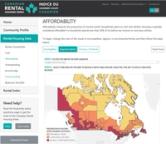
By BC Non-Profit Housing Association
The primary goal of this guide is to provide design recommendations – derived from evidence-based scientific literature – that may enhance mentalwellbeing. This guide hopes to be a benchmark to allow affordable housing stakeholders to consider the psychological impact of certain design elements. This is achieved by considering a balance between the cost efficiency of the design elements, and the benefit as supported by peer-reviewed psychological studies.
Building a Sustainable Non-Market Real Estate Sector will help position housing providers for long-term sustainability and create capacity so that they can make strategic use of real estate assets. Based on feedback collected from the sector, we will develop training workshops and a speaker series for housing providers, empowering them to make use of strategies such as identifying redevelopment potential, real estate financing tools and investment strategies, or leveraging assets through strategic collaboration and partnerships.
In many other Canadian cities, most moderate-income jobs can accommodate a home purchase. In Calgary, it’s a little more challenging. The average price tag on a home in Calgary has increased greatly while salaries have not kept pace. We want to investigate three broad categories pertaining to moderate-income Calgarians who do not own a home:
This project was created to develop a sustainable housing strategy to identify housing needs and gaps within the community and propose innovative solutions to addressing affordable housing and aging-in-place challenges. The project will recommend new models for collaborative partnerships that could be implemented in our community to address housing challenges.
By analyzing and translating the story of the new 45-unit home called Inclusio, Accessible Housing will be better positioned to share their learning with government funders.
By capturing, analyzing, better understanding and then translating the story of the new 45-unit home called Inclusio, Accessible Housing will be better positioned to share their learning with government funders and policymakers, corporate partners, and community organizations. The intention of this initiative is to combine the documentation of key learnings with employee learning and development opportunities, and to ensure these employees have the skills, knowledge, and tools required to share this story with other communities. When well-shared, this story will inspire others to create similar developments in Alberta.
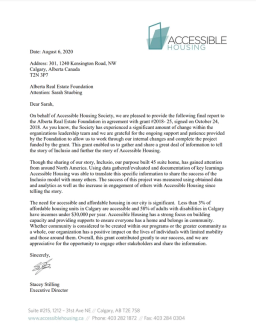
Accessible Housing is a nonprofit organisation and registered charity, which helps open doors to homes that are both accessible and affordable for people with limited mobility, a growing population with unmet needs in the province of Alberta. Recognising a need in the community for increased mobility-restricted and cost-effective housing, the Accessible Housing Society undertook the development a 45-suite home known as Inclusio. Through the initial design, development and operation of Inclusio, Accessible Housing gained a great deal of knowledge about not only construction design and development but also additionally, how the services provided integrate in the most useful way for residents within the building design. Through a generous grant provided by the Alberta Real Estate Foundation, Accessible Housing has been able to gather this learned information and share the story of Inclusio with many stakeholders.
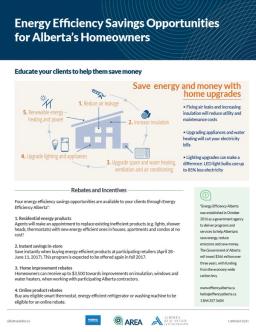
The Alberta Real Estate Association (AREA) has partnered with the Pembina Institute to educate REALTORS® and their clients on the value of energy efficiency. As a collaboration, the project will leverage AREA’s expertise on the needs of REALTORS® and homeowners and the Pembina Institute’s expertise on clean energy, climate change and energy issues to transform how Alberta’s REALTORS® understand and serve homeowners on this topic of increasing importance.